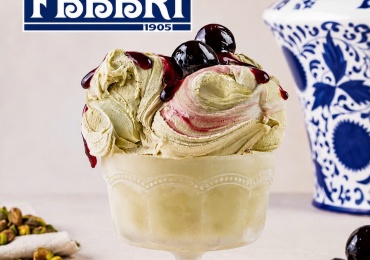
Have you ever wondered: Why does Gelato need to be kept very cold, yet it should not be served at -18°C like conventional frozen ice cream?
A tray of Gelato taken directly from a deep freezer can be so hard that it is difficult to scoop. But when the product is brought to around -12°C to -14°C, Gelato becomes softer, smoother, more elastic, easier to shape, and—most importantly—its flavors become more noticeable.
This is not a random difference. Behind a smooth scoop of Gelato at serving temperature lies a complex balance involving water, sugar, PAC, total solids, fat, Stabilizer, freezing conditions, and storage temperature.
So, what actually happens inside Gelato when its temperature changes?
Let's explore it together with FABBRI 1905 & IKEM.
Mục lục
First, it is important to clarify one point: -12°C to -14°C is generally a reference range for serving/displaying artisanal Gelato. It does not necessarily mean the ideal temperature for long-term storage.
This temperature range helps Gelato achieve a balance between stability and softness.
Therefore, professional Gelato makers need to find the right balance for their specific recipe.
This is also why a good Gelato recipe cannot be evaluated simply by asking: “Does the Gelato taste good?”
You should also ask: “Does the Gelato reach the right serving condition at the target temperature?”
Imagine taking a tray of Gelato at around -18°C and immediately trying to scoop it with a spatula.
You will notice:
The reason lies in water. Gelato contains a significant amount of water. As the temperature decreases, more of that water turns into ice.
When Gelato is brought back to approximately -12°C to -14°C, some of the water is no longer completely frozen, allowing the structure to become softer and more elastic.
That is why Gelato can both hold its shape and remain easy to scoop at the appropriate serving temperature.
This is one of the key differences between simply making ice cream and producing professional Gelato.A frozen product is not simply about lowering the temperature as much as possible.
The goal of Gelato production is to control:
Therefore: Great Gelato is not the Gelato that is frozen the hardest. It is the Gelato with the best-controlled structure.
Have you ever experienced this situation? “The freezer is at -13°C, but the Gelato is still hard!”
Don't immediately increase the freezer temperature.
Instead, look at PAC – Power of Antifreeze. PAC represents the ability of components in the formulation to lower the freezing point.
Simply put: An appropriate PAC level helps prevent Gelato from becoming excessively frozen at serving temperature.
This is why two recipes stored at exactly the same temperature can have completely different textures.
One recipe may have:
Appropriate PAC → soft, elastic, easy to scoop.
Another may have:
PAC too low → hard, difficult to scoop.
Conversely, if PAC is too high:
Gelato may become too soft, melt quickly, and struggle to hold its shape.
This is precisely why recipe balancing is more important than simply adjusting the freezer temperature.
This is one of the most common misconceptions in Gelato making.
Many people think:
“Sugar is only there to make Gelato sweet.”
In reality, sugar also affects:
Most importantly, different sugars do not have the same effect.
Sucrose, dextrose, glucose syrup, fructose, and other sugars can have different effects on sweetness and antifreeze properties.
Therefore, changing the type of sugar without recalculating PAC/POD can significantly change the texture of the Gelato.
A Gelato recipe containing too much free water may result in:
Conversely, a recipe with too little water or excessively high total solids may cause:
Therefore, Gelato makers need to find the right balance between:
This is why a professional Gelato recipe needs to be calculated rather than simply: “Add the ingredients and adjust based on intuition.”
Here is an interesting experiment. Take two different recipes and place them in the same freezer at the same temperature:
Pistachio
and
Strawberry
They can have completely different levels of softness.
Why?
Because each recipe has different:
Therefore:
The range of -12°C to -14°C is an important reference range for serving, but the recipe itself still needs to be properly balanced.
Serving temperature is only the final link in the chain. Gelato quality begins to be determined inside the Batch Freezer.
During batch freezing:
This process helps control ice crystal formation and incorporates air into the Gelato structure.
If the freezing process is not appropriate, even if the freezer is later set to -13°C, the product may still fail to achieve the desired texture.
After leaving the Batch Freezer, Gelato is not yet completely stable.
This is where the Blast Freezer plays an important role.
A Blast Freezer helps rapidly lower the temperature, supporting the control of ice crystal formation and stabilizing the product structure.
It can be understood simply as:
Three pieces of equipment, three different functions.
This is an important distinction to make.
Therefore, it is important not to interpret this too simply: “-12°C to -14°C is the ideal temperature for every stage.”
Each stage has a different purpose.
If Gelato is still too hard, check:
Conversely, if Gelato is too soft or melts too quickly, check:
In particular, if the formulation contains a high amount of free water or PAC is not properly balanced, Gelato may soften quickly even when the freezer temperature is within an appropriate range.
Therefore:
Doing so may make the Gelato harder, but it will not address the root cause of the formulation.
Professional Gelato requires more than just a good machine.
It requires:
This is also why FABBRI 1905 is an important consideration for those developing professional Gelato recipes.
From flavor pastes and Bases to other specialized ingredients, the goal is not simply to create a delicious flavor, but also to achieve a product with:
Clear flavor – smooth texture – good elasticity – stable shape retention – an appealing eating experience
With Gelato, flavor and structure must work together.
If you remember only one thing from this article, remember this:
The most important factor is:
A good Gelato does not require customers to know what PAC is.
It does not require customers to understand POD.
It does not require customers to know how a Batch Freezer works.
What customers actually notice is simply:
That is the ultimate result of a well-balanced Gelato recipe.
Creating truly consistent Gelato requires more than just a recipe.
You need knowledge, ingredients, equipment, and technique to work together.
FABBRI 1905 provides professional Gelato ingredient solutions.
IKEM supports you in understanding ingredients, balancing recipes, selecting equipment, and addressing common challenges in Gelato production.
29.08.2026
28.08.2026

26.08.2026
24.08.2026
21.08.2026
18.08.2026

13.08.2026
10.08.2026
10.08.2026
09.08.2026

07.08.2026
06.08.2026
06.08.2026
05.08.2026
05.08.2026
01.08.2026

31.07.2026
01.07.2026
27.08.2026