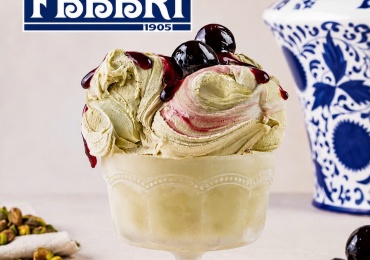
When making Gelato, sugar does more than simply provide sweetness. It is one of the key groups of ingredients that determines the softness, structure, freezing behavior, stability, and overall mouthfeel of Gelato.
When developing a Gelato recipe, three types of sugar are frequently discussed: Sucrose – Dextrose – Glucose Syrup.
But how are they different?
Why can’t they simply be substituted for one another?
When should you use Dextrose? When is Glucose Syrup more suitable? And why does a professional Gelato recipe often use more than just Sucrose?
Let’s explore the role of each type of sugar with FABBRI 1905 and IKEM Co., Ltd.
When making Gelato, many people focus only on:
“What percentage of sugar does this recipe contain?”
However, for professional Gelato formulation, the more important question is:
“What type of sugar does the recipe contain?”
Each type of sugar has different characteristics in terms of:
Sweetness
Ability to lower the freezing point
Total solids
Water retention
Impact on structure
Impact on Gelato softness
Impact on melting rate
FABBRI 1905 also emphasizes that combining sugars such as sucrose, glucose syrup, dextrose, and maltodextrin is important for controlling the freezing point, perceived sweetness, water, crystallization, and melting time of Gelato.
Therefore:
Adding more sugar does not necessarily make Gelato better. What matters is choosing the right type of sugar and balancing the correct proportions.
Sucrose is the familiar refined sugar commonly known as cane sugar or granulated sugar.
In Gelato formulations, sucrose is commonly used as the primary sugar and serves as a reference point for evaluating sweetness and the effects of other sugars on the freezing process.
If we define:
Sucrose = 100
other sugars can be compared relatively in terms of POD – sweetness and PAC – anti-freezing power.
Reference values commonly used in Gelato balancing indicate that sucrose has approximately:
POD = 100 | PAC = 100
Sucrose helps to:
Provide the primary sweetness
Add total solids
Contribute to body
Affect the freezing point
Contribute to Gelato structure
However, if sucrose is used exclusively, it becomes difficult to adjust sweetness and softness independently.
This is why other types of sugar are introduced into the formulation.
Dextrose is glucose in its simple-sugar form and is commonly used as a powder in Gelato formulations.
One of the key characteristics of Dextrose is:
Dextrose is less sweet than sucrose but has a stronger ability to lower the freezing point.
Common reference tables used in Gelato balancing place Dextrose monohydrate at approximately:
POD = 70 | PAC = 173
while sucrose is 100/100.
The exact values may vary depending on the calculation method and the form of the ingredient.
This provides an important advantage.
For example, if a recipe is:
Too hard but already sweet enough
increasing sucrose may not be the optimal solution.
Instead, part of the sucrose can be replaced with Dextrose to increase the freezing-point effect without increasing sweetness to the same extent.
This is one of the reasons Dextrose is often used to fine-tune Gelato texture and softness.
Glucose Syrup is an ingredient derived from starch and contains a mixture of carbohydrates with different chain lengths.
This is an important difference between Glucose Syrup and Dextrose.
Dextrose is a simple sugar, whereas Glucose Syrup may contain glucose, maltose, and longer-chain saccharides.
The characteristics of Glucose Syrup depend significantly on its:
DE – Dextrose Equivalent.
Therefore, it is not accurate to assume that all Glucose Syrups have the same PAC or POD values.
| Ingredient | Relative POD | Relative PAC |
|---|---|---|
| Sucrose | ~100 | ~100 |
| Dextrose | ~70–75 | ~173–190* |
| Glucose Syrup DE 38 | ~50 | ~67 |
| Glucose Syrup DE 42 | ~52 | ~75 |
| Glucose Syrup DE 60 | ~65 | ~119 |
* Dextrose values may vary depending on whether monohydrate or anhydrous dextrose is used and which reference system is applied.
The most important point to remember:
Glucose Syrup should not be replaced with Dextrose at a 1:1 ratio simply because both are sweetening ingredients.
Glucose Syrup also contributes total solids and body, while affecting Gelato structure and softness differently.
This is probably one of the questions that interests Gelato makers the most.
Although both ingredients originate from the hydrolysis of starch, Dextrose and Glucose Syrup do not serve the same function in a Gelato formulation.
Tends to provide:
Lower sweetness than sucrose + stronger anti-freezing effect.
Therefore, it is often useful when you need to:
Adjust softness
Lower the freezing point
Reduce sweetness compared with simply increasing sucrose
Fine-tune the formulation
Tends to provide:
Total solids + body + effects on structure and stability.
Its specific characteristics depend on its DE and total solids content.
Therefore, Glucose Syrup is often useful when you need to:
Increase body
Increase total solids
Support structure
Adjust sweetness
Control melting and crystallization
Technical Gelato references also emphasize that Glucose Syrup and Dextrose can have significantly different effects on Gelato softness and body.
The differences can be summarized as follows:
| Criteria | Sucrose | Dextrose | Glucose Syrup |
|---|---|---|---|
| Common form | Crystals | Powder | Syrup |
| Nature | Disaccharide | Glucose | Mixture of carbohydrates |
| Sweetness | Higher than Dextrose | Lower than sucrose | Depends on DE |
| Anti-freezing power | Moderate | High | Depends on DE |
| Total solids | High | High* | Usually lower than 100% due to water |
| Body | Yes | Yes | Usually more noticeable |
| Softness adjustment | Yes | Very useful | Depends on DE |
| Structural impact | Yes | Yes | Significant |
| Can they be substituted 1:1? | ❌ | ❌ | ❌ |
* With Dextrose monohydrate, the total solids content is not 100% because it contains water of crystallization.
The values above are reference values for formulation balancing, as the actual characteristics of each ingredient depend on its specific form, DE, total solids content, and the manufacturer's technical specifications.
To understand the role of sugar in Gelato more deeply, two concepts are essential:
POD represents the relative sweetness of a sugar compared with sucrose.
The reference point is:
Sucrose = POD 100
A higher POD → tends to be sweeter.
A lower POD → tends to be less sweet.
For example, Dextrose has a lower POD than sucrose.
PAC represents the ability of a sugar to lower the freezing point of a mixture.
Higher PAC generally makes Gelato softer at the same temperature, because more water remains unfrozen.
Lower PAC can make Gelato harder.
This is particularly important when Gelato is stored and served at low temperatures.
Therefore:
POD has a major influence on sweetness. PAC has a major influence on how Gelato freezes and how its texture is perceived at serving temperature.
If you use only sucrose, every adjustment to the amount of sugar simultaneously affects both sweetness and anti-freezing power.
However, a Gelato maker may sometimes want to:
Make the Gelato softer without making it sweeter.
Or:
Increase body without increasing PAC too much.
Or:
Control melting while maintaining a balanced flavor profile.
In these situations, combining different types of sugar allows the Gelato maker to adjust the formulation more precisely.
This is the essence of sugar balancing in Gelato.
FABBRI 1905 has a long history in Gelato ingredients and currently develops a variety of bases for Gelaterias.
According to FABBRI, bases are selected based on various factors, including production techniques, milk powder, fat, protein, fiber, stabilizers, emulsifiers, and the presence of different sugars or sweetening ingredients.
This highlights an important point:
A Gelato base is not simply “powdered base.”
Behind a finished product lies careful consideration of multiple ingredients designed to support the structure and characteristics of Gelato.
One example is FABBRI Base Gelato System, whose published ingredients include sucrose, dextrose, maltodextrin, and glucose syrup, together with other ingredients that support structure.
Another product, Simplé Calamansi & Yuzu, also lists sucrose, glucose syrup, and dextrose, along with fiber, plant protein, emulsifiers, and stabilizers.
This demonstrates that:
In professional Gelato, different types of sugar are often combined to create a balanced formulation rather than being used independently.
There is no single answer that applies to every recipe.
29.08.2026
28.08.2026
26.08.2026
21.08.2026
18.08.2026

15.08.2026
13.08.2026
10.08.2026
10.08.2026
09.08.2026

07.08.2026
06.08.2026
06.08.2026
05.08.2026
05.08.2026
01.08.2026

31.07.2026

01.07.2026
27.08.2026